
For decades, U.S. military airlift has been the quiet backbone of American power, the largely invisible system that allows presidents to move forces across the globe with speed and confidence. From rushing troops to the Middle East to sustaining humanitarian relief after natural disasters, air mobility has long been a reliable constant. That assumption is now under strain, as the operational environment shifts from permissive skies to contested ones, forcing the Pentagon to rethink what airlift must do to remain viable.
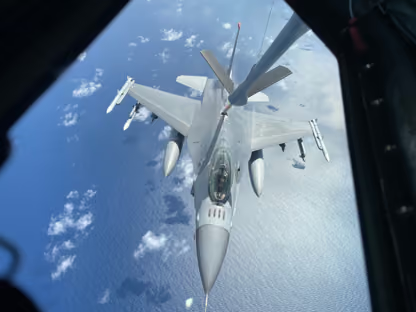
At its core, the American air mobility enterprise was designed for an era of air superiority. Large transport aircraft such as the C-17 and C-5, along with the tanker fleet that keeps fighters and bombers aloft, were built to operate from secure bases, along predictable routes, with little fear of interference. Adversaries have studied that model carefully, investing in long-range missiles, advanced air defenses and electronic warfare (EW) systems intended not just to shoot aircraft down, but to hold them at risk from afar. In a high-end conflict, traditional airlift and high-value airborne asset (HVAA) aircraft may be forced to operate well outside threat envelopes, slowing the flow of forces and supplies at precisely the moment speed matters most. The paradox is stark: airlift is essential to fight, but fighting may be required before airlift can safely function.
Airlift’s apparent flexibility masks a deep dependence on fixed infrastructure. Long runways, fuel farms, maintenance facilities and secure ramps are indispensable, yet concentrated at a small number of well-known overseas hubs. Those nodes are vulnerable to missile attacks, cyber disruption or politically motivated denial of access. Even limited degradation can ripple across an entire theater, constraining sortie rates and forcing difficult choices about what, and who, moves first.
Even with the largest airlift fleet in the world, demand routinely outpaces supply during major contingencies. Aircraft and crews must be triaged among deploying forces, sustaining combat operations, evacuating casualties and responding to crises elsewhere. At the same time, airlift is extraordinarily expensive, consuming vast amounts of fuel and maintenance hours. It excels at speed, but it is ill-suited to sustaining a prolonged campaign on its own. Over time, the strain falls not only on aircraft, many of which trace their lineage to the Cold War, but also on the people who fly and maintain them.
Against this backdrop, a growing consensus has emerged from operational planners: airlift can no longer be treated as a passive enabler operating with impunity. It is now a contested operational domain in its own right, one that must become more resilient, more adaptable and more integrated into the fight. One answer taking shape is to expand what airlift and tanker aircraft actually do once airborne, transforming them from logistics workhorses into active participants in the networked battlespace.
SNC’s Mobility and HVAA Connectivity and Survivability Solutions embody that shift. Built on open architecture principles, SNC provides airlift and aerial refueling platforms with a modular, plug-and-play mission backbone. Rather than requiring costly, aircraft-specific modifications, the system allows new sensors, communications packages and mission applications to be integrated rapidly, extending the relevance of existing fleets while expanding their roles.
In practical terms, SNC’s connectivity and survivability solution turns traditional airlift and tanker aircraft into multi-role platforms. A cargo aircraft equipped with the system might deliver humanitarian aid one day, then be reconfigured with intelligence, surveillance and reconnaissance capabilities the next. A tanker orbiting safely outside a threat ring could serve as a refueling node and as a relay for data, passing information between fighters, unmanned systems and command centers. In this way, aircraft that must already be in the air can become network nodes, contributing to situational awareness and command and control rather than merely transiting from point A to point B. SNC’s Mobility and HVAA Connectivity and Survivability Solutions have flown in several exercises and in support of real-world operations.
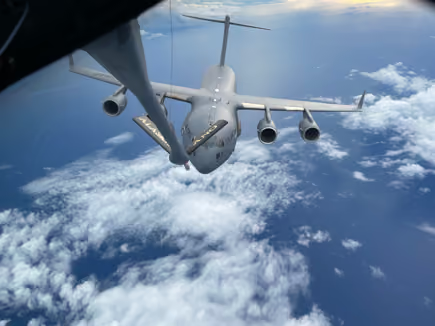
By adhering to open mission systems standards, SNC’s solution enables interoperability across services and allied forces, a growing priority in joint and coalition operations. It also allows the rapid integration of new capabilities as threats evolve. Where proprietary systems often require years to upgrade, an open system can accept new EW tools, communications waveforms or data-sharing applications more quickly. In a contested environment, that agility is decisive.
Modular mission systems also help extract more value from legacy fleets that are expensive to replace and slow to modernize. Instead of retiring older tankers or transports due to outdated avionics and mission systems, the military can upgrade them incrementally, aligning capability upgrades with operational needs. This approach avoids major structural overhauls while extending the usefulness of existing platforms.
Taken together, these changes point toward a different conception of airlift. Rather than a vulnerable logistics tail waiting for permissive conditions, air mobility becomes an active part of the operational fabric, more resilient, more connected and more relevant in contested scenarios. SNC’s connectivity and survivability solution does not eliminate the inherent challenges of airlift: aircraft will still need runways, fuel, access and protection. But SNC is offering a way to mitigate risk by making every sortie count for more than transport.
In past conflicts, airlift was often taken for granted, its success measured by how smoothly it stayed out of the spotlight. In the conflicts that lie ahead, it will be judged by how well it adapts under pressure. Turning airlift and tanker fleets into flexible, networked platforms may not solve every problem, but it reflects a growing recognition that logistics, connectivity and combat power are no longer separate conversations. They are, increasingly, the same one.
About SNC
SNC is a trusted global leader in aerospace and national security. Our innovative solutions enable connected protection through command, control and communications systems, as well as ISR, cyber, electromagnetic spectrum management, and other high capabilities for national security systems across all domains – sea, land, air, space and cyber. As a longstanding leader in defense technology, SNC is at the optimum intersection of commercial, defense and non-traditional contractors. We are one of the only privately owned mid-tier A&D contractors and we pride ourselves on our ability to invest early and often to ensure mission success on or ahead of schedule. It's part of our mission to always stay one step ahead; working on solutions today to solve the problems of tomorrow. Founded in 1963, SNC is owned by Executive Chairwoman Eren Ozmen and CEO Fatih Ozmen.
Contributors
