
Denver, Colorado (CNN) — From hypersonic glide vehicles to swarms of $20,000 drones designed to drain million-dollar interceptors, military and defense leaders gathered recently at the Air & Space Forces Association’s Warfare Symposium and warned that America’s defenses are confronting a threat environment unlike anything seen in decades.
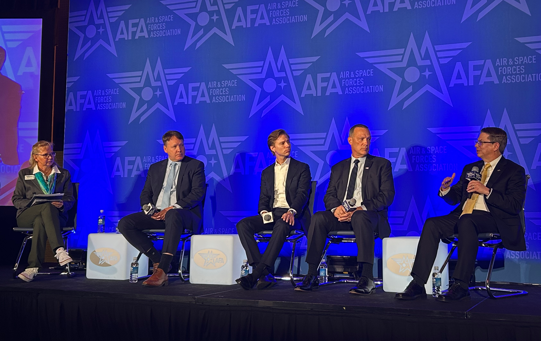
During a panel on integrated air and missile defense, industry executives from Divergent, Lockheed Martin, Northrop Grumman and SNC described a battlefield defined by “mixed salvos,” coordinated barrages of cruise missiles, maneuverable hypersonics and low-cost unmanned aerial systems launched simultaneously from land, sea and air.
“The current threat landscape is vastly different from the Cold War era,” said Jon Piatt, senior vice president at SNC. “Adversaries are deploying inexpensive and rapidly adaptable systems like small UAS, as well as advanced threats like hypersonics.”
A layered response to a layered threat
Industry executives agreed the solution is not simply more interceptors, but more integration.
According to Piatt, SNC has embraced what it calls a layered, scalable approach to air and missile defense. Its Expeditionary Area Air Defense, or EAAD, systems combine modular sensors, electronic warfare and kinetic effectors in an open-architecture framework designed to evolve as threats do.
Systems such as SNC’s BRAWLR and MAAWLR are built to counter targets ranging from small drones to subsonic cruise missiles. The company says its plug-and-play architecture allows third-party sensors and effectors to be integrated in months rather than years, an essential pace as adversaries iterate rapidly.
Artificial intelligence is central to that effort. Panelists described AI-enabled cueing systems that prioritize targets, coordinate multi-layered defenses and reduce operator workload in high-volume scenarios such as drone swarms. By compressing the entire chain of events, automation can shave precious seconds off engagement timelines, a decisive advantage against maneuverable or fast-moving threats.
The enduring role of airborne sensors
While space-based sensing remains critical, particularly for tracking hypersonic glide vehicles that can slip beneath traditional radar horizons, Piatt emphasized that airborne platforms remain indispensable.
“Airborne assets provide persistent, flexible coverage where space-based systems may face limitations,” Piatt said. “They can detect low-flying threats like drones or cruise missiles that might otherwise evade a purely space-based architecture.”
SNC’s PITBOSS platform is designed to integrate airborne and space-based sensors into a unified air picture, he said, enabling near-real-time data sharing across domains. In contested environments, rapidly deployable airborne systems can bridge coverage gaps until more advanced space capabilities are fully operational.
Efficiency and the industrial base
Beyond technology, panelists pointed to acquisition reform and industrial resilience as equally urgent priorities.
Executives called for expanded use of rapid acquisition pathways such as Other Transaction Authorities, harmonized requirements across services and multi-year procurement contracts to stabilize production lines and supply chains.
Piatt said digital engineering has helped streamline integration timelines, while commercial off-the-shelf components and pre-qualified second sources reduce supply chain vulnerabilities.
As the Pentagon seeks to ramp up missile production and fund next-generation sensing, including space-based constellations capable of providing persistent, global tracking, industry leaders argued that open architectures and shared data rights will be critical to avoiding vendor lock-in and enabling seamless integration across platforms.
Closing the session, Piatt underscored the stakes.
“Our approach is built on adaptability, integration and innovation,” he said. “Open architectures, AI integration and public-private collaboration are central to ensuring the U.S. and its allies stay ahead of adversaries.”
With adversaries coordinating across a “multi-axis” threat axis stretching from Moscow to Beijing to Tehran and Pyongyang, the message from Denver was clear: the future of missile defense will depend less on any single interceptor and more on the resilience of the system as a whole.
To view a full recording of this panel, click here.
About SNC
SNC is a trusted global leader in aerospace and national security. Our innovative solutions enable connected protection through command, control and communications systems, as well as ISR, cyber, electromagnetic spectrum management, and other high capabilities for national security systems across all domains – sea, land, air, space and cyber. As a longstanding leader in defense technology, SNC is at the optimum intersection of commercial, defense and non-traditional contractors. We are one of the only privately owned mid-tier A&D contractors and we pride ourselves on our ability to invest early and often to ensure mission success on or ahead of schedule. It's part of our mission to always stay one step ahead; working on solutions today to solve the problems of tomorrow. Founded in 1963, SNC is owned by Executive Chairwoman Eren Ozmen and CEO Fatih Ozmen.
Contributors
